
 Procter Contracts is among the first automatic gate suppliers to achieve Safety Assured accreditation by completing the comprehensive training programme provided in support of the Guide to gate safety legislation and standards developed by the Powered Gate Group of the Door & Hardware Federation (DHF). Jeremy Procter, the Managing Director of Procter Sliding Gates and Deputy Chairman of the DHF Powered Gate Group, comments:”We are fully committed to raising the standard of safety for automatic gates and to supplying our own range of power operated gates that are fully compliant with the detailed guidance contained in the DHF Guide to gate safety. I am very pleased that we are one of the first companies to have been accredited as a Safety Assured gate supplier.”
The DHF guide to powered gate safety was developed with the backing of the Health and Safety Executive (HSE) and following consultation with major equipment suppliers and leading installers. It has now been adopted as best practice technical guidance within the automatic gate industry. Providing a summary of the principal issues, as well as detailed guidance, free publication is providing to be a valuable resource for people needing more information about the safety of powered gates.
A key factor behind the publication of the guide was a number of recent fatal accidents involving powered automatic gates. Procter Sliding Gates is a member of the Powered Gate Group of the Door and `hardware Federation, and the company has been actively involved in drafting the Guide to gate safety and developing the thorough Safety Assured gate supplier training programme; naturally, Procter Sliding Gates is committed to providing fully compliant, Safety Assured automatic gates, and to promoting the Guide to gate safety and the Safety Assured accreditation scheme.
Andy Holz, chairman of the DFH Powered Gate Group, states:”The DHF has extensive experience of setting safety standards for automated doors in other industry sectors, such as powered garage doors. Much of that technical expertise is transferable to the powered gate sector.”
Nick Ratty, the head of the HSE’s services, transport and safety unit, says:”The Health and Safety Executive was consulted in the production of this publication and endorses the sensible advice to installers on managing the risks from powered gates set out in the guidance.”
Follow the link to download a copy of the DHF Guide to gate safety legislation and standards. Alternatively, telephone 0800 2944177 or email [email protected] to request a copy or to inquire about powered gates.
Procter Sliding Gates has published a new guide to automatic gates on its website. This useful resource for specifiers, architects and buyers explains the benefits of automatic sliding gates and swing gates, provides important information about gate safety, and directs readers to further online resources for greater detail about specific topics.
Unlike many other gate suppliers, Procter provides a comprehensive service to survey, design, manufacture and install powered and automated gates, so customers can get unbiased advice about the optimum type of gate for any application, whether that is a swing gate, tracked sliding gate or cantilevered sliding gate. Moreover, Procter offers a range of cost-effective standard gates or can accommodate any level of customisation, ranging from custom colours and logos, or gates manufactured to architects’ designs.
The new online resource explains that manual operation is often adequate for small gates, but larger and heavier gates need to be powered; automation provides for remote operation, enhanced security through better access control, and operational efficiencies.
As the guide says, automatic gates are applicable to a wide variety of premises, including private houses, apartments, industrial and commercial sites, utilities, and high-security facilities such as prisons, airports and military establishments. The choice of gate type, infill and automation will be specified to suit the current and anticipated future application requirements.
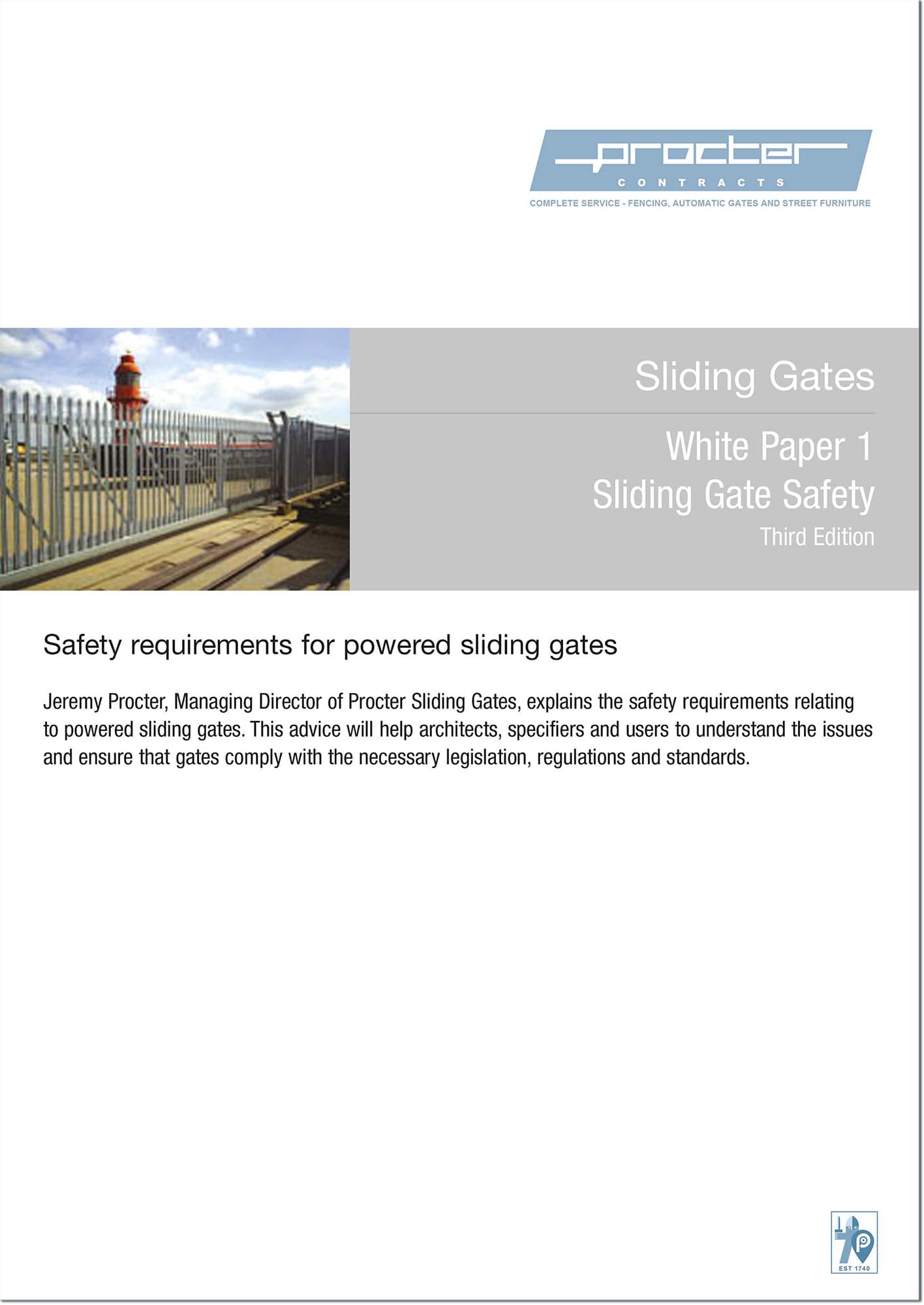
Another important subject covered in the online guide is gate safety. Automatic gates have large and powerful motors, so it is vital that suitable measures are put in place to safeguard users and members of the public, including children. The guide explains how Procter undertakes a risk assessment then installs all necessary measures to comply with the latest standards and guidance from the HSE. Because powered gates are classified as machinery the gates are also CE marked in accordance with the European Machinery Directive 2006/42/EC.
Other topics included in the online guide to automatic gates are quality assurance, installation and maintenance.
Follow the link to view the new online guide to automatic gates or contact the company to discuss specific projects by email [email protected]
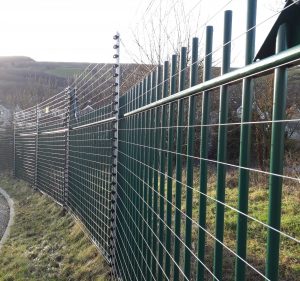
High-security perimeter protection from Procter Contracts
With over 100 years’ experience in fencing and gates, Procter Contracts possesses unrivalled expertise in the design, manufacture and installation of high-security perimeter protection in the form of fencing, gates and associated measures such as access controls, electric pulse systems and sophisticated monitoring systems.
Unless the customer provides a detailed specification, every project undertaken by Procter Contracts starts with a technical consultation and site survey. This helps to establish what type of fencing and additional security features are appropriate to counter the threat and, where appropriate, take into account issues such as aesthetics.
Depending on the outcome of the consultation and survey, it is likely that high-risk premises will require high-security mesh panel fencing or high-security W-section palisade fencing. Where gates are required, whether hinged or sliding, powered or manually operated, the specification for the infill can be the same as the fencing or different. Additional physical security can be provided by means of toppings on the fencing and razor wire at ground level; if there is a risk of burrowing, fencing material can be buried in a formed concrete cill.
For high-security perimeter protection, electric pulse systems are popular today, both on new installations and for upgrading existing fences. Procter Contracts is an authorised installer of the Harper Chalice PulseSecure and PulseSecure PROTECTOR systems, with each PulseSecure system being configured to suit the application. Harper Chalice products are Home Office trialled and approved to the highest ratings.
In addition, Procter Fencing Systems can install a variety of electronic surveillance measures – such as the Harper Chalice FenceSecure fence-mounted perimeter intrusion detection system – as well as acoustic and radar cables, infrared detection, virtual fences and CCTV. Of course, if selected areas on a site do not warrant such high levels of security, Procter Fencing Systems can supply and install alternative types of fencing and gates that are more cost-effective for these applications.
Always using its own teams of trained installers, Procter Fencing Systems has installed high-security perimeter fencing and gates at airports, ports, prisons, utilities and government premises. Customers appreciate the high quality of the products and installation, the comprehensive technical support and the outstanding level of customer service provided by Procter Fencing Systems. The company is also a Secured by Design Licence Holder and, for the installation of prison fencing, on the official Ministry of Justice Compliant contractor List for Fencing.
Procter Fencing Systems has published a ‘Guide to High-Security Perimeter Protection’ a ‘Fencing Selector’ and two White Papers entitled ‘Safety requirements for powered sliding gates’ and ‘How to specify sliding gates’ , copies of which are available as free downloads.
Alternatively, contact Procter Fencing Systems now to discuss any requirements for high-security perimeter protection. Telephone or email [email protected].
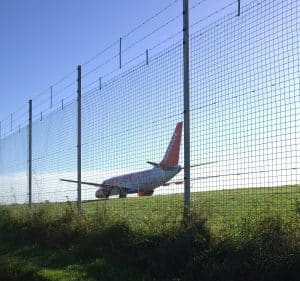
Selecting the optimum type of fencing requires a careful balance to be made between security, aesthetics and cost
Procter Fencing Systems will be on Stand E160 at the Counter Terror Expo 2012, which takes place at London’s Olympia on 25/26 April 2012. With over 100 years’ experience in fencing and gates, Procter Fencing Systems possesses unrivalled expertise in the design, manufacture and installation of high-security perimeter fencing and gates, together with associated access controls, electric pulse systems and sophisticated monitoring systems.
Visitors to Stand E160 can find out about Procter Fencing Systems’ capability for providing complete perimeter security, including fencing, gates, access controls, electric pulse systems, intruder detection systems and additional security measures. Examples of various products will be available on the stand, such as Procter Pro-Mesh high-security welded mesh panel fencing, high-security palisade and other designs of weldmesh fencing. In addition, the company will be exhibiting its comprehensive yet competitively priced Pro-Glide powered sliding gates, as well as powered and manually operated swing gates.
As any authorised installer of the Harper Chalice PulseSecure and PulseSecure PROTECTOR systems, Procter Fencing Systems will be displaying these two alternative electric pulse systems that are suitable for installing on new fences or retrofitting to existing fences, together with the Harper Chalice FenceSecure fence-mounted perimeter intrusion detection system (PIDS). Procter Fencing Systems, which is a Secured by Design License Holder, also supplies and installs acoustic and radar cables, infrared detection, virtual fences and CCTV, and the company’s supply and installation services are blacked up by full technical support and site surveys.
Fencing experts will be on hand at CT Expo to discuss visitors’ requirements for particular sites and for protecting against diverse risks. Although fencing may seem to be straightforward, it is a complex matter to specify the optimum package of fencing, gates and associated security measures in order to provide the right level of perimeter security without being prohibitively expensive. Procter Fencing Systems can help here, drawing on its broad experience of supplying and installing perimeter security for airports, ports, prisons, utilities, military establishments, government premises and other areas with high threat levels.
Visitors to Procter’s stand at CT Expo can also request a CD containing the Procter Fencing Systems ‘Guide to High-Security Perimeter Protection’, a software-based ‘Fencing Selector’ and two White Papers entitled ‘Safety requirements for powered sliding gates’ and ‘How to specify sliding gates’.
Visit Procter Fencing Systems on Stand E160 at the Counter Terror Expo 2012 to request a CD or to discuss any requirements for high-security perimeter protection (visitors are encouraged to pre-register for the event due to the strict admission policy). Alternatively, telephone us, email [email protected].

Register to download Guide to Perimeter Protection Immediately |
High-Security Perimeter Protection explains this complex subject clearly and concisely to enable specifiers, facilities managers, security managers and consultants to identify the optimum security measures for particular premises and threats. It covers not only high-security fencing, barriers and gates, but also electric pulse systems and additional security features such as access controls, CCTV and intrusion detection systems.
In addition, the Guide has a table of British, European and International Standards relating to perimeter security, and lists of useful resources and sources of further information. The Guide, therefore, helps readers to make the right decisions so that the selected perimeter security measures provide the necessary level of protection at an acceptable cost and without unduly compromising aesthetics, for example.
Whether the requirement is to protect against terrorists, extremist protesters or other determined intruders, Procter Fencing Systems can provide the optimum perimeter security system. The company undertakes complete projects, from technical consultations and site surveys, through to design, manufacture and installation. With 100 years’ experience – including the installation of high-security perimeter fencing and gates at airports, ports, prisons, utilities and government premises – Procter Fencing Systems possesses unrivalled expertise, backed by an exceptional standard of customer service.
Guide to High-Security Perimeter Protection is available from the Download section of the website. Alternatively, email [email protected].
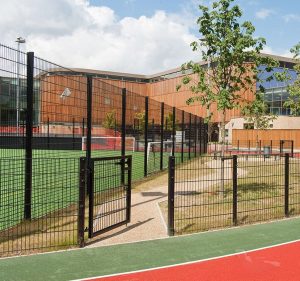 It is possible to achieve school fencing cost savings without compromising security or aesthetics, writes Jeremy Procter, the Managing Director of Procter Fencing Systems.
Although the Building Schools for the Future programme has been terminated, the government is adamant that it will continue to invest in schools, albeit with a strong emphasis on value for money. Meanwhile, existing schools are under pressure to maintain security so as to minimise the risk of theft, vandalism, arson and unwanted visitors who might pose a threat to pupils and staff.
School fencing and gates have an important role to play in security, acting as a deterrent, preventing some intruders from entering, and giving time to enable prospective intruders to be detected and apprehended.
When specifying fencing for schools, several factors have to be taken into account: the level of security required, the aesthetics (schools must remain welcoming for pupils, teachers and parents) and the cost. This can be a difficult balancing act, especially when schools are being told that they must save costs. Nevertheless, it is not inevitable that saving money on fencing will result in unattractive or insecure fencing, as there are several more imaginative ways to save costs.
As with any perimeter security project, the first step is to undertake a risk assessment in order to establish the threats and the level of security required. This is not straightforward, and it is important to get this right: specify inadequate fencing and the result could be unwanted visitors, vandalism, theft or even arson; specify too high a level of security and the costs will rise. If in doubt, engage a security consultant who can advise on all aspects of security, as fencing must work in concert with additional security features such as lighting, CCTV and access controls.
In addition, the risk assessment might identify areas that do not warrant a high level of security, so different types of fencing can be specified for different areas in order to avoid unnecessary expenditure. Alternatively, if high security is only necessary for certain areas, it might be that lower-specification fencing can be erected throughout, with additional security measures used to boost the security of the high-risk areas.
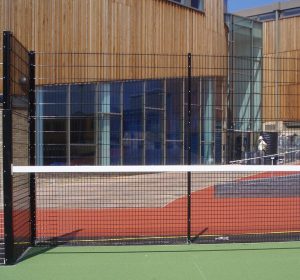
Sportsground fencing also tends to have different requirements so that, for example, lower-cost chainlink fencing can be used around a tennis court whereas mesh panel fencing might be more appropriate for areas where security is the main concern.
One aspect of the fencing that influences the level of security provided is the height, although there is generally a trade-off between height and cost. Fencing is available in a range of standard heights, which will be more economical than specifying non-standard heights. Once again, this decision needs to be based on the results of the risk assessment and any advice received from security or fencing experts. Similarly, standard colours cost less than non-standard finishes.
Fencing can only ever be as secure as the weakest point, and that is often the access points (usually swing gates or sliding gates). Not only is it important to minimise the number of access points (which has the added benefit of saving cost) but the hinges, locks and other fittings need to provide the level of security determined via the risk assessment.
As with any project, it is good practice to obtain competitive quotes from multiple suppliers. However, when reviewing tenders, be sure that you are comparing ‘like with like’ because some companies will use low-quality fencing products that requiring ongoing maintenance or simply do not provide the level of security required. For example, mesh panel fencing is available in a wide variety of styles, with different mesh sizes (a bigger mesh is easier to climb and to cut through), different wire diameters and different finishes (galvanising and powder coating provides a combination of long-term protection and good aesthetics), and the posts and fixings can vary considerably (once again, consider the security, aesthetics and longevity of the alternatives proposed). In addition, note that some fencing companies manufacture and fencing and provide an installation service, whereas others are simply installers who buy-in materials as required and, therefore, have less control over the quality.
Fencing is a more complex subject than many people realise, and it has to be considered as part of the school’s overall perimeter security. Where other measures are being installed – such as CCTV – it is often possible to achieve school fencing cost savings without compromising security as a whole. However, it is always best to discuss the options with security and fencing experts because attempting to save money in the wrong place can be a false economy.
Procter Contracts has accreditation as an installer under the Secured by Design scheme and has published a free guide, Fencing for Schools, the specifier’s guide to perimeter security fencing for schools, to explain the pros and cons of different types of fencing, as well as the other factors to consider when specifying fencing and complementary security measures. The guide will be of benefit to anyone interested in achieving school fencing cost savings and is available directly from the Free Downloads section of the Procter Contracts website. Alternatively, email [email protected]
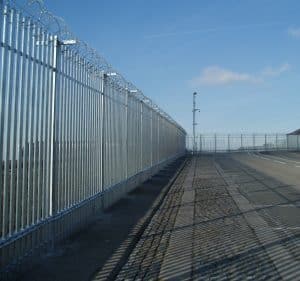
Perimeter Security combats rising crime
With the UK officially in recession, and this being likely to trigger a rise in acquisitive crime, Jeremy Procter, the Managing Director of Procter Fencing Systems, explains how perimeter security fencing can help to deter and prevent theft.
The UK is officially in recession and it is unfortunate that many companies will not only find that business conditions are tough, but they could also fall victim to the rise in crime that Government Ministers are reported to be expecting.
In fact, it is logical that as people find life harder, a minority will turn to acquisitive crime, which means that businesses and other organisations need to take extra care to deter intruders and prevent theft from their premises. One of the most efficacious and cost-effective measures is perimeter security fencing.
First impressions are always important, so intruders will often be deterred from attempting to enter premises with good perimeter security fencing. Potential intruders may also feel that if a business has paid attention to its perimeter security, further security measures will also have been implemented inside.
However, there will be some for which security fencing is not a deterrent. In which case, the type of fencing can make a significant difference in the level of resistance it offers. If a fence takes longer to cut through, there is an increased chance that the intruder will be detected in time. Alternatively, if the intruder attempts to climb over the fence, various styles and types of topping can make breaching the security more difficult. These range from extensions with barbed wire, to purpose-designed rotating metal or plastic spikes.
Perimeter security fencing should be considered within the context of the overall site security, which often includes CCTV (closed-circuit television). If CCTV is being used – or may possibly be implemented in the future – this is an argument in favour of, say, welded wire mesh (weldmesh) panel fencing rather than palisade. This is because CCTV can ‘see through’ mesh panel fencing better than it can with a palisade.
Other factors to consider when specifying perimeter security fencing include the access points (gates and barriers), access controls, and even the optimum type of fence post for the application. There are various fencing-related British and European standards with which to comply, plus local planning restrictions must be taken into account. Aesthetics should also be considered carefully, as employees and customers will find a prison-like appearance very off-putting.
To help people navigate through the complex process of specifying perimeter security fencing and associated measures, Procter Fencing Systems has published All-Round Protection – A Specifier’s Guide to Perimeter Security Fencing. To request a free copy, please email Procter Contracts or visit the Free Downloads section of the website (registration required first).
New Architects’ Guide to Fencing
|
 New Architects’ Guide to Fencing
|
Procter Fencing Systems is publishing a new free guide for architects that explains the differences between alternative types of fencing, how to strike the right balance between security and aesthetics, and what else should be considered at the same time as fencing.
Fencing serves a variety of purposes, including marking the boundary of a property, providing a feature ‘frame’ around a property, preventing intruders from entering and, in some circumstances, ensuring that persons cannot leave the premises without authorisation. In all cases, however, fencing is readily visible, hence there is a need to consider aesthetics as much as other factors. While it might be expected that there is a trade-off between aesthetics and other factors – such as security, durability and cost – fencing that has been carefully designed and specified can enhance the aesthetics of a property while still providing the necessary security and durability at an acceptable cost.
The Architects’ Guide to Fencing explains the different options for fencing, including chain link, palisade, railings, welded wire mesh (weldmesh) and timber, highlighting the aesthetic and security characteristics of each. In addition, the guide discusses other
issues that need to be considered at the same time as fencing, such as gates, barriers and complementary security measures.
Having described the hardware options, the guide presents information that will help architects to make the right selection, as well as listing British and European standards that may be applicable. Finally, the guide explains the importance of correct installation and what should be considered when selecting a supplier.
The Architects’ Guide to Fencing is available from the Free Downloads section or request a copy by emailing [email protected]
Supply and installation of construction site hoardings
|
|

Procter Fencing Systems is expanding its service to survey, supply and install construction site hoardings. Customers can choose from timber or steel hoardings and, after use, Procter can also dismantle and store the hoardings until they are required for the next project.
With construction companies tending to sub-let more work today, Procter Fencing Systems is expanding its construction site hoarding service. The company can survey the site, source the hoarding and install it faster and quicker than the contractor could, and with no risk of comeback to the contractor. Included within the overall service, if required, is the supply and installation of vision panels, gates for pedestrian and vehicular access, lighting and access
controls (keypads, for example). Furthermore, should the hoarding be damaged during use, Procter Fencing Systems can perform next-day repairs to minimise risks to the safety of personnel and site security. Another option is for Procter Fencing Systems to dismantle the hoarding when it is no longer required, remove it from site and store it securely on behalf of the contractor. When it is required for the next project, the hoarding can be re-erected at minimal cost.
Depending on the nature of the project and its location, the hoarding may require additional security measures. If so, Procter Fencing Systems can install hoardings that are taller than the standard height of 2.4m and/or fit toppings such as barbed wire, ‘dragon tail’ effect toppings or electric pulse fencing. While conventional fasteners are normally sufficient, tamper-resistant fasteners can be specified. If the hoarding needs to be installed on sloping ground, infill panels can be made up to close any gaps beneath the hoarding.
Timber hoarding is usually constructed from plywood, though an alternative is Smart Ply Plus that is supplied with a pre-applied protector undercoat to minimise the time required for painting the hoarding after installation. Timber hoardings can either be painted in the colours specified by the contractor or left ready for roll-printed graphics to be applied.
Tougher and longer-lasting, steel hoarding is particularly suitable where long-term costs are a concern and where reuse is anticipated. Both panels and posts can be pre-finished in the contractor’s choice of colour, with the polyester powder coat applied over the top of a galvanised finish. Steel hoarding can either be supplied on demountable posts for flexibility and ease of movement around the site, or fitted to timber or steel posts for additional security.
Whatever your requirement for construction site hoardings, contact Procter Fencing Systems for a competitive quote and an exceptionally high standard of customer service. Email [email protected]
>> Next: Environmental noise barrier systems
>> All Procter Contracts News
The specifier’s guide to perimeter security fencing for schools
New edition of Fencing for Schools, the specifier’s guide to perimeter security fencing for schools
Procter Contracts, one of the UK’s leading specialist manufacturers and installers of fencing and gates, has published a new edition of ‘Fencing for Schools,’ the specifier’s guide to perimeter security fencing for schools. This second edition of the popular publication reflects the new Ofsted guidance for inspectors, introduced in January 2010, plus it contains updated contact details for sources of further information, and the list of British, European and International standards relating to security fencing has been revised in line with recent changes to the standards.
An additional section in the new edition of the guide explains the Secured by Design (SBD) scheme, an official police security initiative that aims to reduce crime through effective environmental design. The guide shows how the use of SBD-accredited fencing products and installers can help to demonstrate that appropriate steps are being taken to reduce crime.
Specifiers often do not appreciate how complex the subject of perimeter security has become. Furthermore, individual projects all have their own needs so must be considered on a case-by-case basis. In terms of fencing, there is a fine balance to be struck between providing adequate security and maintaining an attractive learning environment. Furthermore, fencing has to be considered alongside other security measures, as the optimum type of fencing will depend, to some extent, on the other measures specified. Additional factors to consider range from local planning requirements and standards, through to costs and aesthetics.
‘Fencing for Schools’ explains and illustrates the options available, presents the advantages and limitations of each, and helps readers to select fencing and gates that will achieve the necessary level of security at an acceptable cost and without compromising other areas such as aesthetics.